



For Parents
Welcome, parents! Alphabet Games is a free and safe place for your child to learn letters, sounds, numbers and more through play. This page explains how to get the most out of our games at home, which games suit each age, and how to keep learning fun and healthy.
Why learning games work
Young children learn best when they are having fun. Short, playful games let kids practice the same skill many times without getting bored, which is exactly how early skills like letter recognition stick. Games also give instant feedback, so children feel proud every time they get something right.
Which games suit my child’s age?
Ages 2 to 3: first letters and sounds
At this age, children are just discovering that letters have names and shapes. Choose simple tap-and-find games with bright pictures, songs and big buttons. Focus on fun and familiar letters, like the first letter of your child’s name.
- Alphabet games with letter songs and simple matching
- Color games and shape games
- Animal games to grow vocabulary
Ages 4 to 5: preschool and pre-K
Preschoolers can start matching uppercase and lowercase letters, linking letters to their sounds and counting objects. Games with a little challenge, like puzzles and memory matching, also build focus and patience.
- Letter sound and phonics games
- Number games for counting to 10 and 20
- Puzzle games and memory games
Ages 6 to 7: kindergarten and first grade
Older children can blend sounds into simple words, trace letters and spell short words. Look for games that ask them to build words, read simple sentences and solve early math problems.
- Letter tracing and spelling games
- Word building and early reading games
- Addition and subtraction games
How to teach the alphabet at home
- Start with your child’s name. Children love finding the letters in their own name, and it makes those letters meaningful.
- Teach sounds, not just names. Knowing that “b” says /b/ helps children read much sooner than knowing the letter name alone.
- Go little by little. Many reading programs start with a few common letters, such as s, a, t, p, i and n, because they can quickly be blended into simple words like “sat” and “pin.”
- Mix screen and real-life play. After a game, hunt for the same letter around the house, in books or on signs outside.
- Repeat often, but keep it short. A few minutes every day works better than one long session a week.
- Celebrate effort. Praise trying, not only getting it right. Confidence keeps kids coming back to learn.
Healthy screen time
Learning games work best as one part of a busy, active day. Major health organizations such as the American Academy of Pediatrics and the World Health Organization advise limiting screen time for young children, choosing high-quality content and joining in when you can. Some simple tips:
- Keep sessions short, around 10 to 20 minutes for young children.
- Play together when you can. Talk about the letters, sounds and pictures you see.
- Avoid screens during meals and in the hour before bedtime.
- Balance screen time with outdoor play, books, drawing and building.
- Use a timer so the end of game time feels fair and predictable.
Your child’s safety on Alphabet Games
- No sign-up: children never need to create an account or give their name.
- No chat: our games have no chat or messaging features.
- No targeted ads: any ads are non-personalized and kept separate from the games.
- Reviewed games: every game is checked for learning value and age-appropriate content before it goes on the site.
You can read the full details in our Privacy Policy.
Playing on iPad, tablet and PC
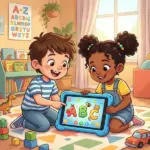
All of our games run in the web browser, so there is nothing to download or install. On an iPad or tablet, children can play with a finger. On a PC or laptop, a mouse works best for little hands. For the best experience, use an up-to-date browser such as Safari, Chrome or Edge, and turn the sound on, since many games use spoken letters and sounds.
Quick tips for happy learning
- Let your child choose the game. Choice builds motivation.
- Stop while it is still fun, so they look forward to next time.
- Replay favorite games. Repetition is how skills grow.
- Connect games to everyday life, like counting stairs or spotting letters at the shop.
Questions or ideas?
We would love to hear from you. If you have a question about a game, an idea for a new one or feedback about our site, email us at [email protected] or visit our Contact page.